At Children’s Action Alliance, we believe every Arizona lawmaker has a responsibility to vote for kids. And we believe Arizonans deserve to know when they do.
Our 2026 Legislative Scorecard tracks key votes affecting children’s education, health, safety, and economic well-being, giving you a quick, simple way to see where your elected representatives stood.
See how your lawmakers scored and let them know you’re watching.
Virtual Community Briefing: No More Cuts for Schools: What You Need to Know About Prop 320
For decades, Arizona’s public schools have suffered an increasing list of funding blows, from the state budget failing to fully fund school buildings to losing students to the universal expansion of the Empowerment Scholarship Account (ESA) program.
Prop 320 will be yet another financial hit to about 707,300 students in public schools if approved by voters this November. It requires more funding for teachers, general supplies, and cocurricular activities from public school budgets without new dollars– forcing schools to decide between cutting funding from other vital public school services or risk losing money for teachers.
Join Children’s Action Alliance, the Arizona Center for Economic Progress, and public school experts for a virtual community briefing breaking down what Prop 320 means for children attending public schools, families, teachers, and school budgets.
Attend to learn why you should vote NO on Prop 320!
Can’t join during the day? Come to our virtual evening session.
Protect Head Start: Tell HHS to Keep Essential Services for Children and Families
For 61 years, Head Start has helped children and families thrive by providing early learning, health services, family support, and developmental care. Now, proposed federal changes could weaken the standards that make these essential services possible- including protections that help ensure young children receive safe, high-quality care and families have access to critical health and developmental supports.
Why It Matters: The proposed changes to Head Start would undermine the requirements that make it one of the nation’s most successful early learning programs. Changes could weaken safety protections, reduce essential health and developmental services, eliminate important mental health supports, and roll back other requirements designed to support the whole child and family.
Arizona families deserve better. Head Start is more than an early learning program- it connects children and families to the supports they need to thrive. We need to protect the standards that have served generations of children and families.
Take Action!
We are joining our partners at the Arizona Head Start Association and the Arizona Early Childhood Alliance in calling on the U.S. Department of Health and Human Services to protect Head Start and preserve the essential services and safeguards that children and families rely on.
To celebrate 61 years of Head Start- let's make sure there are 6,100 voices speaking up for our children and families.
We Can’t Leave Families on the Bench: It's Time for Paid Family Leave
As the world comes together to celebrate the FIFA World Cup 2026, we are reminded of something bigger than the beautiful game. 48 nations from across the globe are showcasing their best: teamwork, resilience, and a commitment to helping their countries succeed - both on and off the field.
But when it comes to supporting families, the United States’ standing remains in last place.
Every country competing in the FIFA World Cup guarantees paid leave for new parents, except for one. That's right - the United States remains the only country in this tournament without a national paid family medical leave policy.
In fact, the United States is one of only 7 countries left in the world that lacks a national paid leave program, putting them in the same bracket as Marshall Island, Micronesia, Nauru, Palau, Papau New Guinea, and Tonga.
Research consistently shows that paid family leave improves infant and maternal health, increases workforce participation, and strengthens financial stability. Yet too many parents are forced to return to work just days or weeks after the birth or adoption of a child because they simply cannot afford to take unpaid time off.
As United States’ fans cheer for their team in this Cup, we must shoot for another goal worth fighting for: ensuring every family can provide needed care for their family without risking their financial future. The 2026 World Cup reminds us that is far past time for the United States to stop sitting on the sidelines and join the rest of the world in guaranteeing Paid Family Medical Leave.
Read more about the benefits of paid leave and information by clicking below.
CAA Names David Lujan Executive Director
Children’s Action Alliance’s board of directors has named David Lujan as Executive Director of Children’s Action Alliance. In a statement, Board Chair, David Higuera, said, “David Lujan has shown time and time again that he is dedicated to the well-being of children in Arizona because he knows a strong foundation for Arizona’s children is a strong foundation for this state. The board is excited to welcome back David, who recently led the state agency charged with the safety of children, and previously was a tremendous leader for Children’s Action Alliance.”
David previously served as the CEO/Director for the Arizona Department of Child Safety and in K-12 education leadership roles. David’s prior history with CAA began in 2016, as the inaugural director of The Arizona Center for Economic Progress to advance policies that create fairer tax codes and better economic opportunities for all Arizonans. He then was appointed by the board to serve as CAA’s CEO and President. Before joining CAA, David worked in public policy in Arizona for over 20 years in several roles including a former member of the state Senate and House of Representatives, as an attorney for a nonprofit assisting abused and neglected children, and as an assistant attorney general advising the School Facilities Board.
CAA announced in February that January Contreras, CAA’s current Executive Director, would be departing CAA this month. “We would also like to express our deepest gratitude to January Contreras for her leadership since 2023, and for her support of this leadership transition for the important work of CAA.”
We are excited to welcome David to our team!
Celebrating January's Leadership at CAA
Last night, Children’s Action Alliance and community members joined to share thanks with January Contreras, CAA's Executive Director, on her last day of leading our mission for Arizona’s children and families.
Thank you to Mayor Kate Gallego for the fun and special proclamation naming June 17th, 2026 as January Contreras Day, and to Congressman Greg Stanton for sending a Congressional Certificate of Commendation.
Our special thanks to the partners and supporters who joined us last night and who stand up for Arizona’s children every day beside CAA.
The CAA team thanks January for her many contributions and the lasting impact she’s had on those we serve!
Arizona Ranks 40th in 2026 KIDS COUNT Data Book
Arizona ranks 40th overall in child well-being, up from last year’s ranking of 42nd, according to the 2026 KIDS COUNT Data Book, a 50-state report of recent data developed by the Annie E. Casey Foundation. The data show a step in the right direction and also that Arizona leaders must do more to put affordable housing, health care, and preschool within reach of families to meet unmet needs.
“Families who are working so hard to rise above the poverty line are also facing higher costs for food, gas, housing, and child care. When a family’s purchasing power is decreasing, it’s hard to catch up and feel peace of mind. The tough decisions that come with financial stress impact the whole family, including kids,” said January Contreras, Executive Director of Children’s Action Alliance, a member of the Casey Foundation’s KIDS COUNT network.
The current and prior KIDS COUNT DATA Books show that:
In 2024, the share of children in Arizona living in poverty remained unchanged from the prior year’s 15% in 2023. The national rate is 15%.
The share of children in Arizona living in households with a high housing cost burden remains stubbornly high at 29%, nearly one out of every three children. The national rate is even higher at 31%.
The share of children in Arizona who are uninsured continues to be among the highest in the country at 9%. The national rate is much lower at 6%.
The share of three and four-year old children not in school in 2020–2024 in Arizona is 65%, significantly higher than then the national rate of 54%.
36% of children in Arizona live in single-parent families compared to the national rate of 34%.
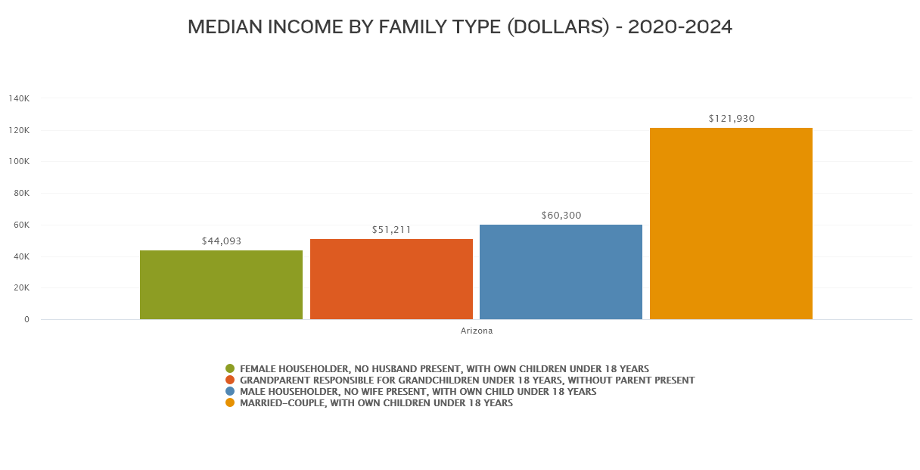
According to the KIDS COUNT Data Center, the median income by family type varies widely: In Arizona, the median income for a two-parent household with children is $121,930; for a single father with children is $60,300; for a grandparent raising a grandchild without a parent in the home is $51,211, and for a single mom with children is $44,093. Policymakers must understand that disparities in family income often impact a child’s opportunities and access to health care, food, housing, and child care.
In addition to comprehensive data available at the Data Center, the Data Book reports on 16 indicators of child well-being based on data from 2019 to 2024. Arizona’s highest ranking was in economic well-being where the state ranked 31st, and its lowest ranking was in education, where Arizona ranked 47th, among the five lowest scoring states in the country, according to the 2024 data in the Data Book.
Children’s Action Alliance recognizes important actions taken by Governor Hobbs and the Arizona State Legislature including increased funding for affordable child care, and expansion of Kids Care for children in working families, and ensuring school meals are available to eligible children. We encourage lawmakers and communities to unite across party lines and respond at all levels of government by investing in young people.
As the Governor, legislature, and local leaders set the course for Arizona, Children’s Action Alliance urges policies that include:
Staffing, technology, and public education to ensure that eligible children and families are not prevented from basic services through Arizona Health Care Cost Containment System (AHCCCS) and the Supplemental Nutrition Assistance Program (SNAP) simply due to costly and complicated administrative burdens imposed by new federal laws and regulations;
Increased access to affordable child care;
Increased access to affordable housing; and
Increased support through the kinship stipend to support grandparents and kin raising their grandchildren; and
Uninsured Rate for Our Youngest Children Rising at an Alarming Pace
The uninsured rate for our nation’s youngest children is rising at an alarming pace, and the trend should be a wake-up call for Arizona’s policymakers. After years of progress, more infants, toddlers, and preschoolers are going without health insurance. It’s a troubling reversal that puts young children’s health and development at risk while adding financial stress for families already stretched thin by rising costs.
A new report from the Georgetown University Center for Children and Families (CCF) shows that more than 43,200 children ages 0-6 were uninsured in Arizona in 2024. The report shows that 9 percent of Arizona’s children under age 6 were uninsured in 2024, compared to 7.4 percent in 2022. Unfortunately, Arizona ranks well above the national share of 5.3 percent and has the third highest rate of uninsured children under 6 in the nation.
The findings highlight what’s at stake for our youngest children:
More young children are losing coverage. Babies, toddlers, and preschoolers are seeing sharper coverage losses than older children just as they need important check up appointments.
Coverage protects families from rising costs. Health insurance helps families afford care, avoid medical debt, and give young children a healthier, more stable start.
Without action, more children could lose coverage. Medicaid cuts and new administrative hurdles could make it harder for families to get and keep health insurance for their children.
Research shows that Medicaid coverage for children is linked to better access to care and improved health, educational, and economic outcomes in adulthood. Access to health care is especially important for infants, toddlers, and preschoolers, who require frequent visits to the doctor during their earliest years of life. When young children are insured, families have a better chance of detecting developmental delays and other health issues that can affect a child’s ability to learn. The American Academy of Pediatrics recommends 12 checkups by the time a toddler turns 3, helping ensure children are developing properly and receiving the preventive care they need.
More recent enrollment data adds to the concern. Georgetown CCF’s Medicaid and CHIP enrollment tracker has recorded nearly 75,000 fewer children (-11.3%), enrolled in Medicaid/CHIP since January 2025 in Arizona.
The situation in Arizona could have been even worse, but Governor Hobbs and the Arizona Legislature scored a bipartisan win for children when they expanded the Children’s Health Insurance Program (CHIP) – Kids Care – to 225% of the Federal Poverty Limit beginning in 2024, allowing over 22,000 more children to qualify for health care coverage.
Coverage matters for parents, too. When parents lose their health coverage, their children are more likely to become uninsured, putting the whole family at risk of financial hardship.
We can all agree that no child should have to go without health care. Children’s Action Alliance urges Arizona lawmakers to take action to reduce the number of uninsured young children and ensure eligible children can get and keep affordable health coverage. As Arizona’s budget negotiations are finalized, it is critical Arizona’s leaders provide funding for AHCCCS and DES to meet the implementation challenges of H.R.1 and prevent even more children from losing health care coverage.
SNAP and Food Security Update in Arizona
Arizona Children and Families in Need
Arizona is experiencing a rapid decline in enrollment in Supplemental Nutrition Assistance Program (SNAP) which is putting Arizona children and families at risk of going hungry. In the past year, over 47% of Arizonans have lost their SNAP benefits, with almost half of the children enrolled in SNAP losing access to help that puts food on their tables.
A steep decline has occurred since H.R.1, formally titled One Big Beautiful Bill, went into effect. From August 2025 to February 2026, enrollment in Arizona declined at an alamering pace. Over 400,000 Arizonans – with more than 175,000 children – have lost critical support they rely on to afford groceries. The enactment of this harmful federal law dramatically shifts costs to states and increases hunger in our nation. Arizona has seen the greatest drop in enrollment of any state in the country.
New SNAP Tracker Shed Light on Impact to People
While the federal administration moves to reduce and eliminate data, the Center on Budget and Policy Priorities (CBPP) is working to preserve it. CBPP created a SNAP tracker so we can understand how loss of food assistance is impacting our state.
What Can Help Children and Families?
While work continues to retract the harmful federal H.R. 1, we must mitigate the number of eligible Arizonans who lose SNAP benefits due to implementation of this harmful federal law.
Children’s Action Alliance is advocating for the following:
At the State Legislature:
CAA urges the legislature and Governor to include $16.6 million in the state budget this year for the Arizona Department of Economic Security to modernize and staff their SNAP eligibility and enrollment systems to keep up with the changes required by H.R. 1.
CAA urges opposition to legislation that creates additional obstacles and bureaucracy for administration of the SNAP program for Arizonans. Governor Hobbs has vetoed such bills and we implore her to continue to do so.
In Congress:
CAA urges Congress to delay the unprecedented shift of SNAP costs to states for two years. Like bipartisan calls from state and local leaders from across the country, we continue to sound the alarm about the harm that is being experienced and how that will accelerate without congressional intervention.
Our families, neighbors, and community members should not go hungry.
Cookie Consent
We use cookies to improve your experience on our site. By using our site, you consent to cookies.
Websites store cookies to enhance functionality and personalise your experience. You can manage your preferences, but blocking some cookies may impact site performance and services.
Essential cookies enable basic functions and are necessary for the proper function of the website.
Name
Description
Duration
Cookie Preferences
This cookie is used to store the user's cookie consent preferences.