Are Arizona’s 3-Year-Olds Healthy and Ready to Learn?
A Look at Early Childhood Development Data
Early childhood development is not just cute preschool pictures, it is about the foundation we set for a child’s lifelong success. By the time a child is 3, their brain grows to about 80% of adult size and 90%, nearly full grown, by age 5. The early years of a child’s life are critical for building the foundation of learning, health, and wellness needed to succeed in school and later in life. That’s why the latest national and state data on 3-year-old development, including a troubling picture for Arizona, deserves our attention.
What Does “Healthy and Ready to Learn” Mean?
The “Healthy and Ready to Learn" measure, developed from the National Survey of Children’s Health (NSCH) and analyzed by Child Trends, assesses whether children ages 3 to 5 are on track developmentally across multiple key domains, including:
- Early learning skills
- Social-emotional development
- Self-regulation
- Motor development
- Health
A child who scores “on track” across these areas is considered “healthy and ready to learn”, which means the child has the foundation they need to succeed as they enter school and begin formal learning. Nationally, about 64.1% of 3-year-olds in the United States met this standard. As that is encouraging, there’s significant variation across states.
Why Arizona’s Youngest Learners Need Our Attention
While a majority of children nationwide are on track, Arizona’s data tells a different story. Many states exceed the national average for children considered ready to learn. However, Arizona is among those with some of the lowest readiness rates, ranking second lowest nationally at 48.9% in the percentage of 3-year-olds considered “healthy and ready to learn” compared to other states. This means a much smaller share of Arizona’s 3-year-olds are developmentally on track compared to their peers across the country.
Factors for Arizona’s challenges may be deepened by issues such as:
- Low preschool access and enrollment: Arizona ranks low in preschool enrollment, which contributes to fewer early learning opportunities than most states.
- Child well-being struggles: Arizona ranks among worst states for childhood well-being at 42nd overall. This is largely due to the education category, where the disparities are evident among Arizona’s youngest learners.
Children Ages 3 and 4 Not Enrolled in Early Learning
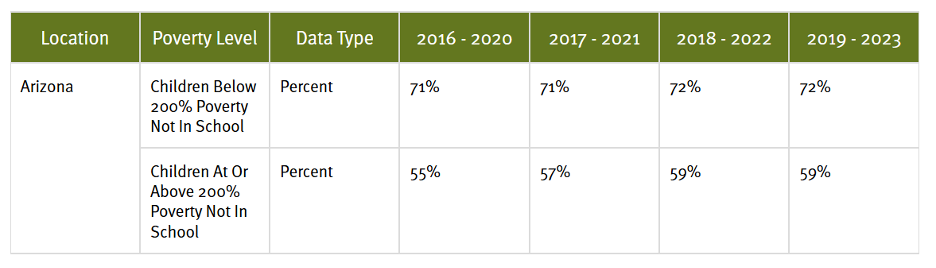
Together, these trends show that Arizona is not providing enough support early enough. If we invest early, we can have the greatest long-term impact.
What Arizona Can Do
Arizona’s low ranking is not just a statistic- it must be a call to action for our policymakers. To improve early childhood outcomes, Arizona must:
- Increase access to quality preschool
States with universal or state supported preschool programs often see higher readiness percentages. Programs that serve children ages 3 and up help build early learning and social skills that are essential for kindergarten success. - Invest in early childhood support services
From developmental screenings to high-quality child care and early learning settings, investments now can reduce costly challenges later. - Support families and caregivers.
Programs that help families with parenting resources, child care, and health access create environments where children can thrive - Expand quality early childhood infrastructure.
Supporting the early childhood workforce and providers, improving child care capacity, and ensuring that families with low-incomes have access to quality early learning are critical steps.
A Future Where Every Child Is Ready
Arizona’s youngest learners deserve better. At Children’s Action Alliance, we believe that every child should have the chance to succeed, and our investments must reflect that long before kindergarten. An overwhelming majority of Arizona’s funding for early childhood programs is from the federal government, leaving a small portion of dedicated funding from state and local sources. Bipartisan efforts by Governor Hobbs and the Arizona Legislature have made the largest state investments in child care in more than a decade but more is needed. By focusing on early childhood development, especially in underserved communities, Arizona can close gaps, strengthen our K-12 education system, and build a more equitable future for all children.
As negotiations take place on Arizona’s next state budget, we urge policymakers to continue increasing funding for affordable child care and services that support the development and school-readiness of Arizona’s youngest children. We especially encourage a budget that prioritizes reducing the child care assistance waitlist and make funding available for a child care infrastructure grant program for rural and underserved communities.