
Category: State Budget

Governor Ducey’s proposed budget - The good, the bad and more tax cuts

Last spring when the COVID pandemic began, the legislature passed a basic “skinny budget” so they could rapidly end the legislative session and return home. At that time, with large portions of the economy shutting down and thousands of Arizonans losing their jobs, state budget experts were predicting a $1.1 billion shortfall for the fiscal year and an even larger shortfall for the coming fiscal year. But, unexpectedly, instead of ending fiscal year 2020 with a shortfall, the state’s ending balance was more than $370 million. This was largely due to an infusion of federal dollars, including about $396 million in federal COVID relief dollars that Governor Ducey used to pay for state agency operations that normally would be paid with state general fund dollars. Increased federal unemployment payments and two rounds of stimulus checks also contributed to what the governor’s budget projects is a $1.1 billion ending cash balance for the current fiscal year and a projected $923 million revenue surplus, after the governor’s spending proposal, for the coming fiscal year.

Governor Ducey released his fiscal year 2022 budget proposal last week which centers around a phased-in tax cut that would grow to a cost of $600 million in three years. If passed, and combined with the $386 million in tax cuts enacted in 2019, would result in nearly $1 billion less in revenue each year.

Governor's proposed budget changes compared to previous year
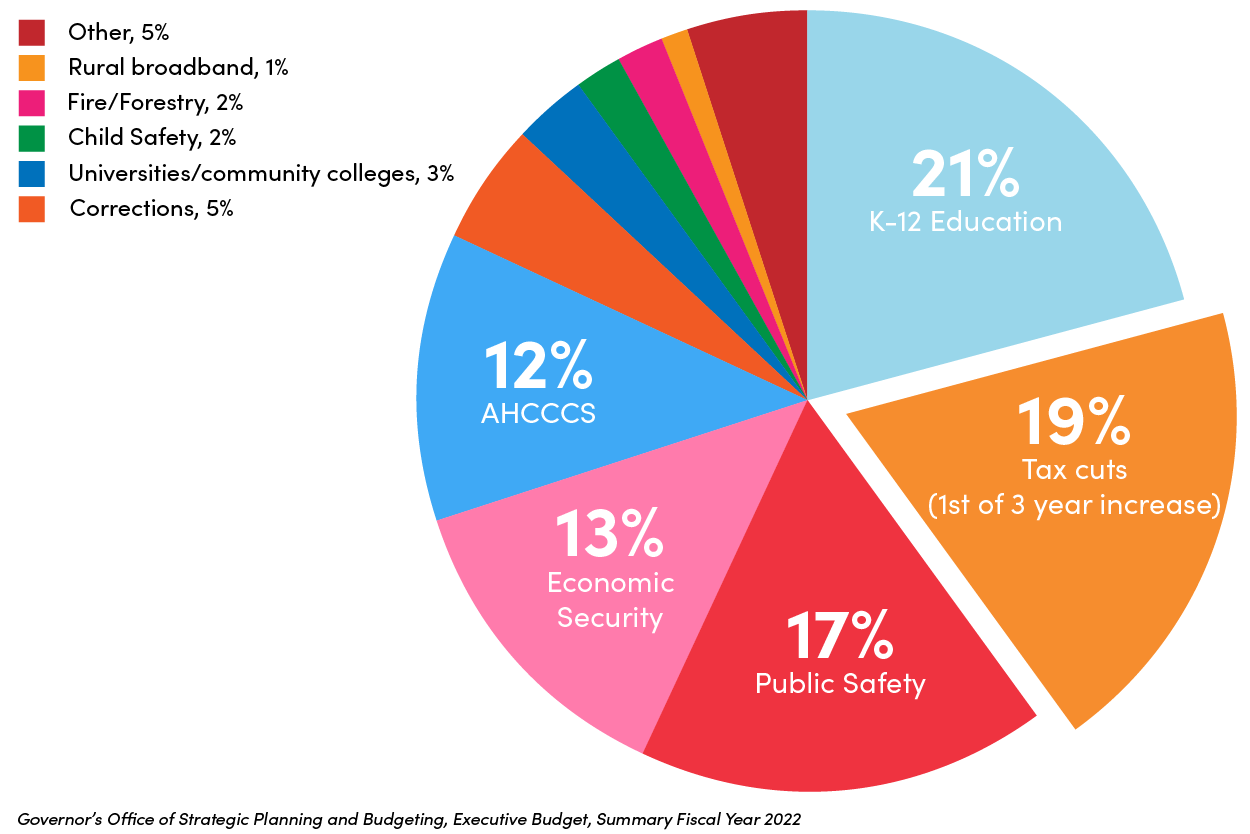
 

What is missing from the Governor’s budget proposal are the investments needed to help Arizona’s children and families get through the health and economic crisis, like:

  • Increasing child care subsidy reimbursement rates to provide safe, quality child care options for working parents of young children;
  • Making up for the estimated $389 million in state funding that Arizona’s public schools will lose during the pandemic due to declining enrollments and reduced formula funding for virtual instruction than in-person instruction;
  • Expanding eligibility for food assistance resources;
  • Making health care more accessible for Arizona’s children by expanding eligibility for KidsCare, Arizona’s Children’s Health Insurance Program;
  • Doubling the kinship stipend from $75 to $150 per child per month for children the Department of Child Safety places with grandparents and other relatives.

The Governor’s budget does include some important investments, like:

  • $18 million to fund the continuation of the childcare waitlist and for a new pilot program that provides child care to children of parents pursuing education and nursing degrees;
  • $92.7 million in supplemental funding for the stabilization of child care centers and to further support providers during the pandemic;
  • $10 million to renew and bolster the Rural Broadband Grant Program.

In the coming weeks, Governor Ducey and lawmakers will begin to negotiate what the final budget will look like. With so much economic uncertainty still present, we will continue to urge them that now is not the time for more tax cuts and they should instead pass a budget that puts the needs of Arizona’s children and families first.

State of the State

This week, the Arizona legislature begins its work for the year at a time when many Arizona children and families are struggling to meet their basic needs during this health and economic crisis. Recently released data by the U.S. Census Bureau shows 1 in 6 Arizona households with children (16%) said they had only slight confidence or no confidence at all that they would be able to make their next rent or mortgage payment on time. Increasing numbers of Arizona households with children are also reporting they do not have health insurance and/or do not have enough food to eat, and communities of color are disproportionately suffering.

That is why it will be so critical for lawmakers to focus their work on helping families achieve financial stability, and keeping children healthy and safe during these difficult times.

Our 2021 legislative priorities include:

  • Making health care more accessible for Arizona’s children by expanding eligibility for KidsCare, Arizona’s Children’s Health Insurance Program;
  • Restoring supports to grandparents and other kinship caregivers who step in and prevent children from entering foster care when parents are unable to care for their children;
  • Provide safe, quality child care options for working parents of young children by increasing the child care subsidy reimbursement rates;
  • Providing Arizona’s public schools with the same amount of funding for conducting virtual schools during the pandemic as they receive for in-person instruction.

What Arizona does not need is more tax cuts which will only reduce state revenues that struggling Arizona families are counting on to provide housing and food supports, and make child care more affordable. Rather than shortsighted tax cuts, we urge Governor Ducey and lawmakers to take a more responsible approach and prioritize a plan to stop the uncontrolled spread of COVID-19, and put Arizona on a path to recovery from this health and economic crisis.

Read our 2021 Legislative Priorities

KIDS COUNT Data Book is the only source to focus on statewide trends about Arizona’s children

Children’s Action Alliance (CAA) is proud to present the 2020 Arizona KIDS COUNT Data Book—the only biennial source to focus on statewide trends about Arizona’s children. Thanks to the support of the Annie E. Casey Foundation, this powerful resource helps inform decision-makers and stakeholders about the economic, social, and physical well-being of children and their families throughout the state. In addition to the Data Book, statewide and county indicators can be found on our new and updated website – along with other resources, toolkits, and information on how to advocate for children and families.

As you know, CAA regularly uses data as a compelling tool to find common ground across geography and political ideology to create an Arizona where every child is safe, loved, and has access to quality education and affordable health care. In this KIDS COUNT Data Book, the data show Arizona has made important strides in improving the conditions for children since the Great Recession - before the unprecedented challenges our communities, our state and our nation have faced due to the COVID-19 health crisis.

The 2020 Arizona KIDS COUNT Data Book offers a closer look at the strengths and contributions of immigrant families as more than 1 in 4 children are growing up in an immigrant household and 6 in 10 Arizona children are children of color.  Despite the changing demographics in the state, children of color are more likely than their White peers to lack the fundamental supports to grow up healthy and strong. It is our hope that YOU - lawmakers, advocates, and state agency leaders use the information in this Data Book to address the long-standing structural inequities in our state. It is time to move towards an Arizona that provides opportunity for all children, not a privileged few.

As advocates for children, we will continue to challenge ourselves to think creatively and critically to find new ways to support Arizona’s children and families. Join us and use the Data Book and other resources on our new website to spark action for measurable and positive change.

ACTION ALERT: Tell Congress to Include every American Family in COVID-19 Relief and Recovery

The U.S. Senate finally introduced their version of the next COVID-19 relief bill and a vote could come as early as this week. Though there is speculation that the new bill doesn't have the votes to pass, now is a critical moment to reach out to lawmakers. With this next legislation, we have an opportunity to put our stated values into action and include families of all backgrounds in the recovery. Join us on this day of action for immigrant families by contacting your senators to let them know how you feel.  

Even though 1 in 4 children in Arizona have a parent who is an immigrant, the previous federal COVID-19 relief packages left out entire households, simply because of one parent’s citizenship status. In Arizona, 104,000 children live in an immigrant household that did not receive a stimulus payment due to an ITIN filing. Nearly, 1 out of 6 immigrants in Arizona works in an essential job, including caring for sick and elderly people, growing food, and keeping grocery stores stocked. Additionally, many immigrants and low-income Arizonans have not had adequate access to COVID-19 medical services. It’s critical that testing, treatment, and vaccines are readily available to everyone, regardless of their ability to pay or immigration status.

  • Roughly 45% of all confirmed COVID-19 cases in children (age 0-17) are Latino but, Latinos make up 25% of the U.S. child population (data as of August 13, 2020).
  • Nineteen percent of non-elderly Latinos had no form of health insurance before the pandemic. As of July 21, more than 22% of Latinos report having no form of health coverage.
  • Throughout July, 21% of Latino households with children have food insecurities.
  • A recent poll by UnidosUS in Arizona, Florida, and Texas, more than 40% of laid off Latino workers did not know if they qualified for unemployment insurance. Of those who applied, roughly one-third were rejected or never heard back.

Immigrants are valued members of society, and the exclusion of certain immigrants undermines our economic recovery and public health. CAA believes that we are stronger when everyone in society gets the same chance to thrive and succeed. Email Senators Sinema and McSally today and demand a more inclusive recovery bill that provides health access and economic relief to everyone. 

COVID-19 State Policy Agenda

The Arizona Senate re-convened last Friday and notified the House that it plans to adjourn. The House appears to be more divided and has yet to indicate if it will follow suit. Whether the legislature will continue the current session or agree to end session and wait for Ducey to call a special legislative session is very unclear at this point. What is clear to us at Children’s Action Alliance are the critical actions state lawmakers must take to ensure that children and families’ needs are addressed during this crisis.

CAA has been working with stakeholders to identify the key state policy asks for COVID-19. Among them are to:

  • Place a moratorium on youth aging out of extended foster care at age 21 and provide placement and other supports for them.
  • Urge Governor Ducey to utilize COVID-19 emergency funds to provide grandparents and other informal kinship caregivers access to “child-only” TANF.
  • Make it easier to extend health coverage to more people, particularly those that find themselves newly uninsured.
  • Appropriate $88 million in federal child care money to provide financial support to centers so that they aren’t forced to shut their doors permanently.
  • Invest in broadband infrastructure in rural and tribal areas to reduce disparities in access to education and telehealth services.

Read more about our policy asks here. The CAA team continues to work with impacted individuals, lawmakers, and other stakeholders to lift up the needs of families already pushed to the edge. We will continue to provide you updates and more in-depth information in the coming weeks.

COVID-19 Relief Package Four: Children and Families Must Be a Priority

CAA is paying close attention to reports that members of Congress are currently negotiating a fourth COVID-19 package. Our team has worked with stakeholders across the state to identify key priorities for children and families and sent each member of Arizona’s Congressional delegation our asks.

Though the federal government has already passed several pieces of COVID-19 response legislation, states like Arizona will need more resources to combat the pandemic and help working families survive the economic contraction. Many of the resources for children and families that were cut during the great recession still have not been fully restored. According to an early estimate, Arizona could have a $1.1 billion state budget deficit by the end of the coming fiscal year, due to a tax revenue shortfall from the COVID-19 pandemic.

This is why it is most important that any new federal legislation include further financial relief to help states balance their budgets and avoid the type of drastic cuts we saw during the Great Recession.

Other key asks are to:

  • Increase fiscal support dedicated to childcare for a total of $50 billion to offer immediate relief to families, childcare providers, and educators during this crisis.
  • Preserve health coverage by providing additional federal match dollars for Medicaid.
    Expand stimulus payments to immigrant families who filed 2018 and 2019 taxes under an Individual Tax Identification Number (ITIN).
  • CAA appreciates the Congressional delegation's leadership for their hard work during these unprecedented times. We encourage them to continue to prioritize the needs of children and families and to help Arizona balance its budget. Both are critically needed to help Arizonans get through this crisis.

Legislature Passes "Skinny Budget" And Legislation to Address COVID-19

On Monday, the Arizona legislature completed its work to pass the budget for the fiscal year and adjourned until April 13.

With a few exceptions, the “skinny” budget strips out one-time funding and increases spending in areas that require annual adjustments such as K-12 education and AHCCCS. The budget also continues to phase in the 20 percent teacher pay increases and the restoration of district and charter additional assistance in K-12 education.

Building renewal for district schools has increased by $119 million of which $28 million is supplemental funding for the current fiscal year.

Using Federal Child Care Block Grant Funds, the budget funds childcare subsidies for 3,000 additional children and increases rates for childcare providers with quality ratings of 3 to 5 stars.

The bare bones budget leaves out several of CAA’s priorities for children and families:

  • Restoring supports to grandparents and other kinship caregivers who step in when parents are unable to care for their children
  • Raising the childcare subsidy reimbursement rates for all childcare providers to help working parents with high out-of-pocket costs
  • Providing comprehensive dental care for pregnant moms participating in Medicaid/AHCCCS

In response to the evolving issues surrounding COVID-19, the legislature authorized $50 million for deposit into the new Contingency and Safety Net Fund. These funds may be spent only after the governor declares a state of emergency. These funds are restricted to housing assistance, including eviction and foreclosure prevention; services for persons experiencing homelessness, including shelter, clothing, food and transportation; food bank operations; and assistance to businesses with fewer than 50 employees, health care providers and nonprofit organizations.

Call Senator McSally: Arizona’s Families Need Financial Relief NOW

Arizona will soon feel the one-two punch of the costs of a large-scale public health emergency and a deep economic shutdown. We will need substantial financial relief to address our health needs and avoid deep budget cuts affecting children and families.

Things are moving rapidly in Washington as Congress continues to negotiate a COVID-19 economic stimulus package.

Now is the time to let key members of Congress know we need a comprehensive stimulus package to help regular Arizonans struggling to make ends meet.

Call Senator McSally now and let her know Congress must act to:

  • Boost the federal match to Medicaid/AHCCCS to help us through the health crisis AND stimulate our state economy.
  • Expand access to the Unemployment Insurance system so that more workers who lose their jobs qualify.
  • Provide fiscal relief to the states to help fend off a state budget shortfall, which could lead to big cuts to public education funding and other critical needs like the more than $1 billion shortfall that happened during the Great Recession.
  • Support Arizona families by helping to keep food on their tables with additional food assistance through SNAP (formerly food stamps).

The measures recommended here are proven to be most effective in reducing poverty and stimulating the economy during a recession.

These are extraordinary times that call on everyone to work collectively to ensure we all get through this together. Please, make a plan to call Senator McSally TODAY.

Children’s Action Alliance Supports Pro-Immigrant Legislation

Children’s Action Alliance applauds Governor Ducey and legislative leaders for listening to constituents and stakeholders by pulling the harmful “sanctuary city” bills last week.

Today, nearly one in seven Arizonans were born outside the United States, and one in four children are growing up with at least one immigrant parent1. Immigrants make up a vital, educated, and skilled share of Arizona’s economy with more than 16 percent as business owners2.

As workers, business owners, taxpayers, homeowners, and neighbors, immigrants are integral to Arizona’s diverse communities and make contributions that benefit us all. We believe that families and communities across our state are strongest when everyone has an opportunity to participate in the economy.

Therefore, the legislature should be committed to policy solutions that remove barriers to opportunities for all Arizonans including:

  • Joining the twenty-one states and D.C. that have adopted inclusive “tuition equity” laws and policies enabling all students to have access to higher education by allowing all Arizona high school students; regardless of immigration status, to pay in-state tuition at public colleges and universities.
  • Expanding access to health coverage to all children regardless of immigration status, can lead to better long-term health outcomes, greater high school and college completion, and long-term economic benefits for the child and local communities.
  • Allowing immigrants who are undocumented to obtain driver’s licenses. This will help immigrants have better access to jobs and improve public safety.

Sources: (1)U.S. Census Bureau, American Community Survey, 2018 1-year estimates. (2)Fiscal Policy Institute analysis of U.S. Census Bureau, American Community Survey, 2015 4-year estimates, IPUMS and 1-year estimates.